The lessons we teach are often the very ones life invites us to practice ourselves.
At Life’sWork Yoga & Wellness in Frederick, Maryland, Breathe-Move-Rest is a practical approach to mind-body wellness that brings together breath awareness, intentional movement, and restorative practices to support people through change.
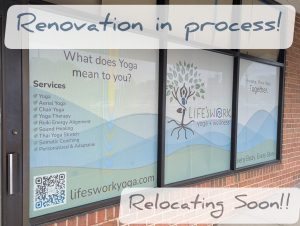
As I navigate the renovation and relocation of Life’sWork Yoga, I’ve found myself returning to the three anchors of our practice: Breathe-Move-Rest. What began as a framework for supporting the body and nervous system has become a reminder of how to navigate change, uncertainty, and growth in everyday life.
Breathe reminds me to pause, notice what’s happening, and make room for what I’m experiencing rather than immediately trying to fix it. Renovations rarely unfold exactly as planned, and relocation has brought its share of unexpected turns. Sometimes the most helpful thing I can do is take a breath, reconnect with my intention, and remember why I started.
Move reminds me that growth requires action, adaptation, and a willingness to keep going—even when the path looks different than expected. There are decisions to make, plans to revise, and new possibilities to explore. Moving forward doesn’t always mean moving faster. Sometimes it means changing direction, asking for help, or taking the next small step.
Rest reminds me that not every moment calls for effort. There are times to step back, allow things to unfold, and recognize that recovery is part of the process, not a detour from it. I’m learning that building a space devoted to healing and well-being also means honoring those needs in myself.
Together, Breathe-Move-Rest offers a way to meet life as it is: becoming aware of what we need, responding with intention, and allowing ourselves time to integrate what we’re learning.
A New Chapter
As Life’sWork enters a new chapter, I’m discovering that the journey isn’t just about creating a larger studio or a beautiful new home for our community. It’s also about practicing the very things we hope to cultivate in others: patience, resilience, flexibility, and trust in the process.
Because whether we’re navigating a renovation, recovering from a setback, or finding our way through a season of change, we don’t have to have every step figured out.
Sometimes, we just need to breathe through the uncertainty, move with intention, and rest long enough to recognize how far we’ve come.
This past year has presented moments to breathe through uncertainty, moments to keep moving forward, and moments when the best-laid plans have required me to pause, reassess, and begin again.
Here are some key lessons I’ve discovered along the way.
1. Growth asks us to make room for what we cannot yet see.
Sometimes the vision arrives before the path is clear. I knew Life’sWork needed more room to grow: more space for small-group practice, more private treatment rooms, and more opportunities for people to receive individualized support. But knowing what we’re building and being able to see how it will all come together are two different things.
The renovation has required me to hold a vision that I couldn’t always see or touch yet.
The lesson: Growth begins with the willingness to imagine something beyond what currently exists, and then we keep showing up for it even when the next step isn’t obvious.
I’m learning that I don’t need to see the whole path to keep believing in the direction I’m going.
2. A delay is not necessarily a denial, but it does ask something of us.
I’ve experienced firsthand that a timeline is not always within my control. There have been shifting expectations, the anticipation of getting into the space, and even receiving the keys without initially being able to enter. The July 1 occupancy plan changed, too.
When we invest so much emotionally, financially, and practically in a project, delays can feel personal. They challenge our patience, confidence, and ability to stay connected to the original vision.
But this process is also teaching me the difference between being committed to an outcome and insisting that it happen on my preferred schedule.
The lesson: Patience isn’t passive waiting. It’s learning to respond to what is actually happening without abandoning what matters to you.
I’m learning that I can be deeply committed to where I’m going without needing to control exactly when I get there.p
3. Recovery is not a step backward. It is part of moving forward.
I built Life’sWork around the understanding that healing, restoration, and supportive care aren’t luxuries or detours. They are foundational to sustainable growth. And yet, when you’re the one responsible for making the vision happen, it can be tempting to push through, do more, solve everything, and keep going regardless of the cost.
The renovation has been an opportunity to really practice what I teach: noticing what is needed, adapting to changing circumstances, and recognizing when effort needs to be balanced with rest and support.
The lesson: You cannot build a sustainable space for healing by sacrificing your own well-being in the process.
I’m learning that rest doesn’t take me away from the work. It helps me return to the work with greater clarity, resilience, and intention.
4. I can be capable and still need support.
A project of this magnitude asks a lot of one person. There are decisions to make, finances to manage, people to communicate with, problems to solve, and a operations to keep running while the future home is being created.
I’ve also explored this lesson within my own recovery story: how difficult it can be to let others see that I’m struggling, especially when I am accustomed to being capable and taking care of things myself.
The renovation has offered another opportunity to practice receiving help, allowing others to contribute, and letting my community be part of the journey rather than feeling that I must carry every piece alone. I’m still learning this lesson, every day.
The lesson: Self-reliance is a strength, but it doesn’t have to mean doing everything yourself. Receiving support is not a failure of leadership; it can be an expression of trust.
I’m learning that I can be strong, capable, and committed while still allowing myself to be supported.
5. The environment we create is part of the care we offer.
Our vision for the new studio isn’t simply about adding square footage. Were intentionally creating a space that feels safe, grounded, welcoming, and conducive to healing.
The smaller practice groups, private treatment rooms, thoughtful lighting, natural textures, absence of mirrors, and attention to sound and privacy all reflect a deeper understanding: the environment influences how we experience ourselves.
This is one of the most meaningful aspects of the renovation. We are attempting to translate the Life’sWork philosophy into a physical space.
The lesson: Our surroundings communicate what we value. The way we design a space can help people feel that they don’t have to perform, prove anything, or be anything other than where they are.
I’m learning that creating a healing space is about more than how it looks. It’s about how people feel when they enter, what they’re able to let go of, and what becomes possible when they feel supported.
6. Sometimes the vision grows along with us.
I opened Life’sWork in 2018, navigated multiple moves in a short period, weathered the pandemic, and established a home where the studio has served the community for years. Now we’re stepping into a new chapter, one that asks for greater space, new systems, deeper collaboration, and a different level of leadership.
This isn’t simply an expansion of the business. It is an evolution of the role I play within it.
This next chapter requires me to think not only about the practices I teach or the people I personally serve, but also about the environment, team, partnerships, and structures that will allow Life’sWork to thrive beyond what I can do alone.
The lesson: To grow into the next version of a vision, we sometimes have to grow into a new version of ourselves.
I’m learning that the next chapter isn’t just asking me to build something bigger. It’s asking me to become a different kind of leader, one who can nurture the vision without needing to personally carry every part of it.
7. Making a space for others has also been a process of learning how to make room for myself.
Renovation has opened a whole new level of uncertainty and challenged me to make room.
- Room for uncertainty.
- Room for things to take longer than expected.
- Room for support.
- Room for rest.
- Room to change my mind, adjust my plans, and begin again. Again.
Perhaps this is what makes this particular chapter so meaningful. At Life’sWork, we aren’t just teaching people how to do yoga. We’re helping each student to navigate change, recover from setbacks, or create a more supportive relationship with themselves. And what’s really amazing: we’re living these lessons in real time.
The renovation has become a practice of its own. Not a practice in getting everything right, but in returning to what matters when things don’t go as planned.
Five takeaways:
- Trust the vision, but stay flexible about the path.
- Patience is an active practice, not simply passive waiting.
- Recovery is part of growth, not a detour from it.
- Allowing support is a strength, not a weakness.
- Grow in alignment with your values, not just your goals.
This renovation is teaching me that building something meaningful requires more than a vision and the determination to make it happen. It requires patience when the timeline changes, flexibility when the plans evolve, courage to ask for and receive support, and a willingness to practice what I teach. I’m learning that growth isn’t always about doing more or moving faster. Sometimes it’s about creating the space, within ourselves and around us, for what matters most to take root.
It’s not perfection, but practice; not forcing the process, but learning how to meet it; and its not simply building a new space, but creating a home for the next chapter.



Leave a Reply